| | | | January 2026 • Issue No. 24 | | The Latest at Harvard Law School's
Food Law and Policy Clinic | | 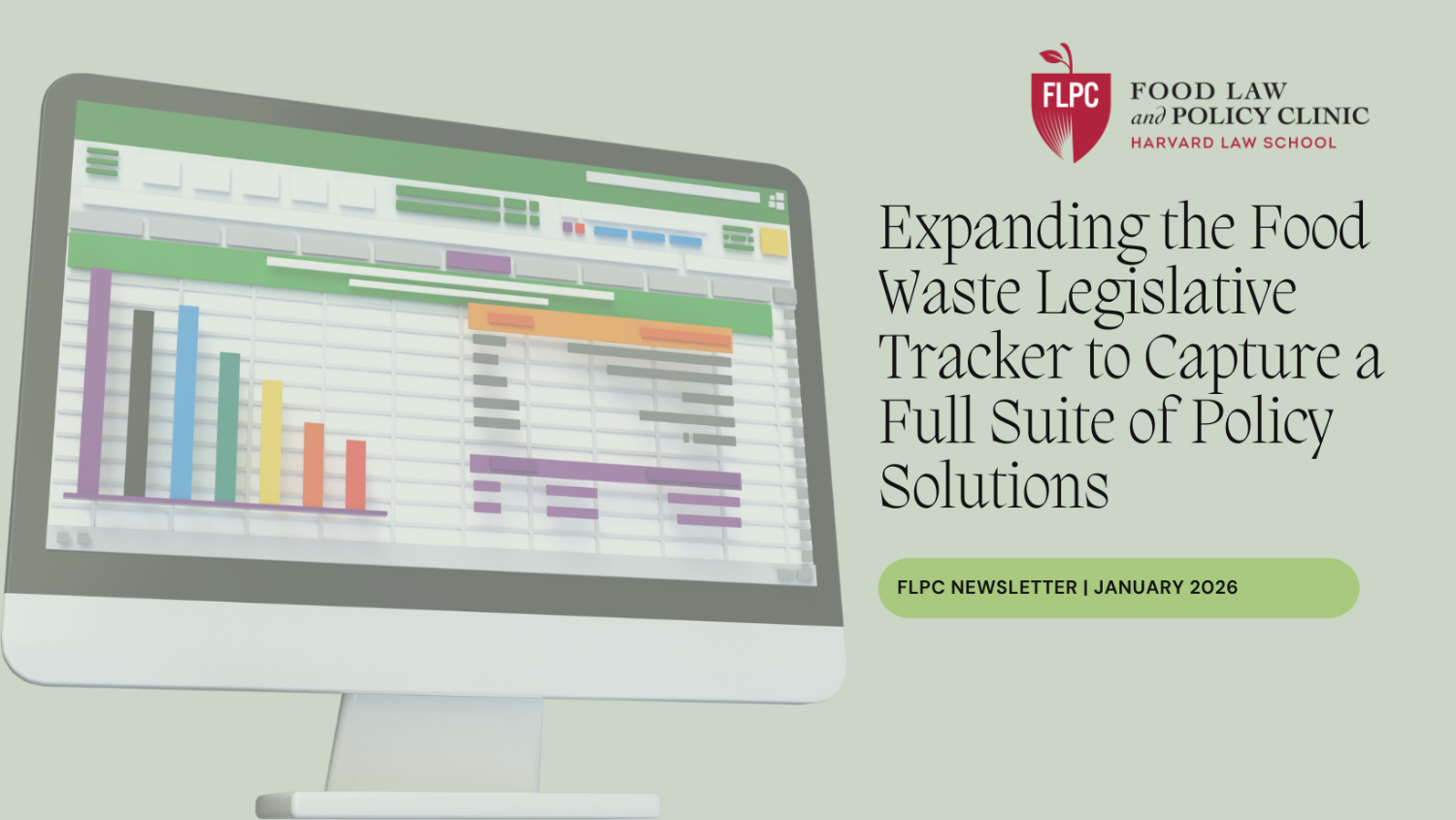 | Expanding the Food Waste Legislative Tracker to Capture a Full Suite of Policy Solutions | | Over the past decade, FLPC has tracked state food waste policies to help us share with our partners and policymakers the ways that states are taking action to reduce food waste. States have such an important role to play in this space, especially because they oversee management of solid waste, along with permitting and licensing for most food retail and food service operations. Since its launch in August 2024, the Food Waste Legislative Tracker—developed by Divert, the Harvard Law School Food Law & Policy Clinic (FLPC), and the Zero Food Waste Coalition (ZFWC)—has provided a first-of-its-kind, national snapshot of state food waste policy, as our effort to make the tracking we have been doing more available and accessible in real time. The Tracker compiles and summarizes bills across all 50 states and the District of Columbia, focused on wasted food prevention, food rescue, and food waste recycling, and specifically on policies such as Organic Waste Bans, Edible Food Recovery, By-Product Procurement, and Date Labeling. The tracker has helped advocates, policymakers, and other stakeholders understand evolving food waste legislation and identify opportunities to engage with legislators in their own communities. Beginning this year, the Food Waste Legislative Tracker will capture an expanded set of policy topics that states are considering for food waste reduction. New categories to the tracker include Animal Feed (laws governing how food scraps can be safely used to feed livestock), Awareness (such as Food Waste Awareness weeks and consumer education campaigns), and Composting/Anaerobic Digestion (AD) Permitting (clarifying where composting and AD can occur and under what conditions). The Tracker will also now follow policies that support the underlying infrastructure for change, including funding mechanisms dedicated to food loss and waste programs, food waste reporting requirements, and research initiatives such as task forces or studies to evaluate food waste interventions. The updated Tracker will also cover additional topics that fall outside of the above categories. By expanding the categories we track, FLPC and our partners aim to give advocates, legislators, and community organizations a more complete picture of the policy tools available to reduce food waste nationwide, and to support continued progress toward the national goal of cutting food waste in half by 2030. Explore the 2026 Food Waste Legislative Tracker here. Read on for more details, insights, and updates on our work and the field. Please also stay engaged with us by subscribing to our listserv and follow us on social media. Sincerely,  Emily Broad Leib,
Clinical Professor of Law, Harvard Law School
Faculty Director, Food Law and Policy Clinic (FLPC)
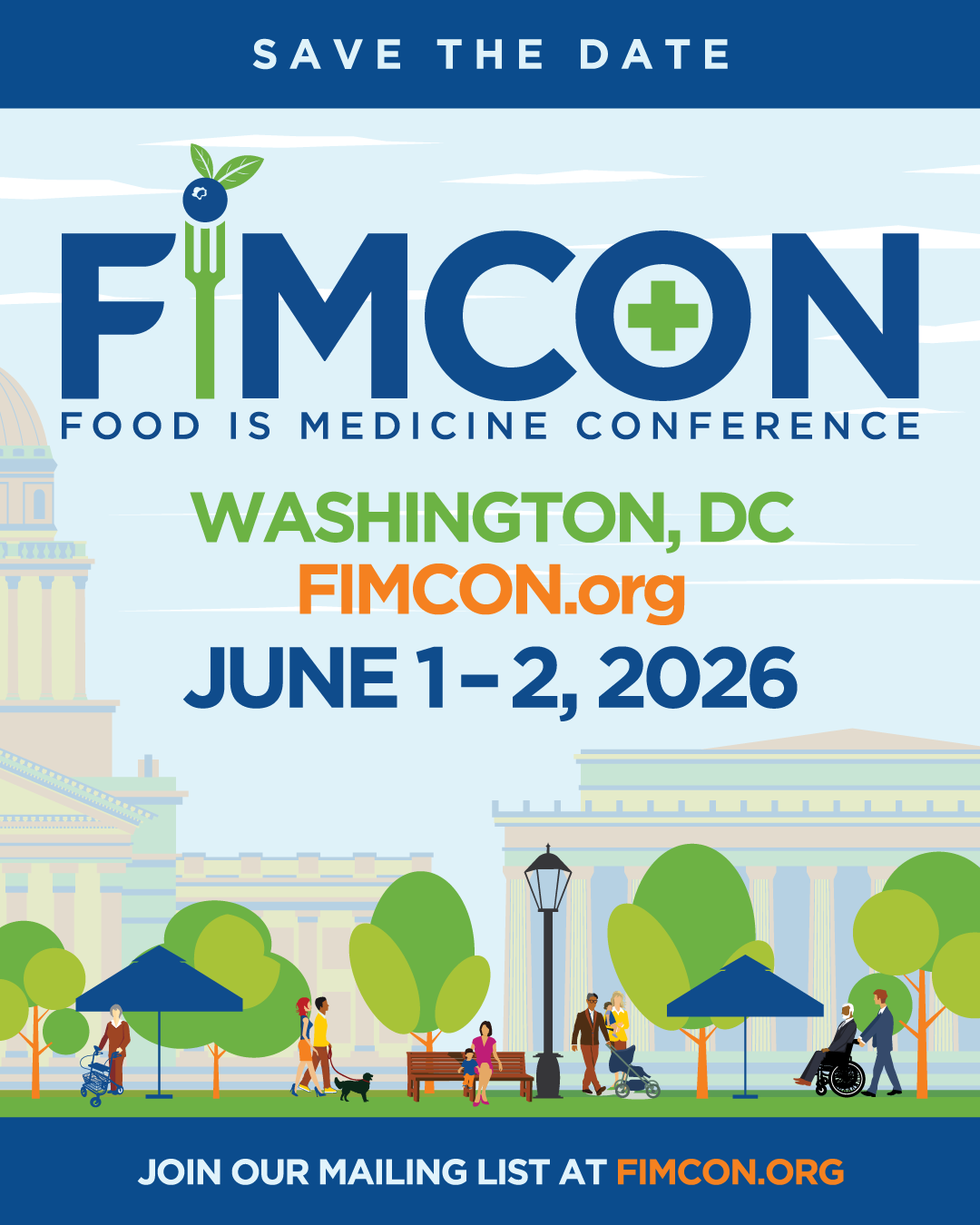
Faculty Director, Center for Health Law and Policy Innovation (CHLPI) | | | | | | | | | | FIMCON: Food is Medicine unites in Washington D.C in June Save the date: June 1-2, 2026 For the first time, leading organizations advancing Food is Medicine are joining forces to launch FIMCON (the Food Is Medicine CONference), a national event uniting the full ecosystem transforming how America thinks about health, nutrition, and care. More than 750 healthcare professionals, FIM practitioners and program participants, researchers, policymakers, community leaders, and funders will gather for a unified, large-scale convening of the entire Food is Medicine field. FIMCON is organized by a coalition of Food is Medicine partners including the Center for Health Law and Policy Innovation (CHLPI) and the Food Law and Policy Clinic (FLPC), the Food Is Medicine Coalition (FIMC), the National Produce Prescription Initiative, and the Tufts Food Is Medicine Institute. Learn more and join the mailing list: FIMCON.org | | Gray Norton becomes Clinical Instructor at FLPC In December 2025, Gray Norton was promoted from Senior Clinical Fellow to Clinical Instructor at the Food Law and Policy Clinic. Gray joined FLPC in January 2023 as a Clinical Fellow and previously worked with the clinic as a summer intern and research assistant. She is passionate about the right to food and envisions a more just and resilient food system that acknowledges and benefits all people. Gray’s portfolio currently focuses on FLPC’s Food System Justice, Food Access & Nutrition, and Climate & Sustainability initiatives. She also supervises the Harvard Law School Mississippi Delta Project. Congratulations Gray! | | | | | | | |  | State Regulation of Food Additives and Chemicals: Preemption, the Commerce Clause, and the Breadth of State Authority This report analyzes federal preemption and the broad authority that states have to enact laws addressing additives and chemical safety in food. The report focuses on four types of common state bills introduced or enacted last year. Two types of bills mirror the 2023 California Food Safety Act (banning certain additives in the food supply) and 2024 California School Food Safety Act (banning artificial color dyes in school foods), and the other two would require warning labels on foods with certain additives, or require disclosure to the state of foods using substances that were determined “generally recognized as safe” without government oversight. | |  | | |  | New Jersey Food Donation Guidelines Along with several other organizations, the Food Law and Policy Clinic served as a partner in the development of food donation guidelines for the State of New Jersey. Published in October, these guidelines are intended to promote increased food donation and provide reference to relevant federal and state laws, as well as applicable food safety requirements and guidance for food donors and food recovery organizations. | | |  | | | 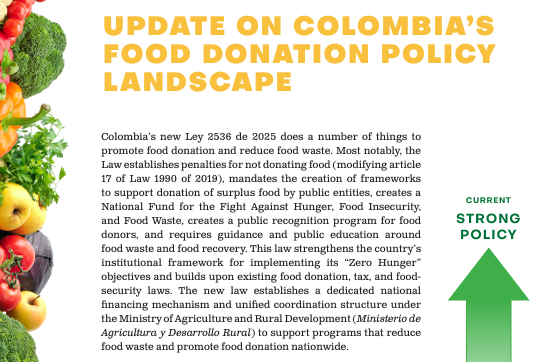 | Update: Colombia Adopts New Food Donation Law FLPC provided an update on Colombia’s food donation policy landscape in November, analyzing a new food donation law adopted by Colombia in 2025. It highlights key provisions in the new law, such as penalties for businesses that fail to donate edible surplus food, new financing and coordination mechanisms, and public education and donor recognition requirements. | | 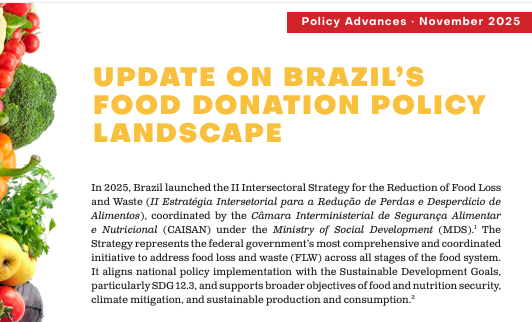 | Update: Brazil Publishes New National Food Waste Strategy The Food Law and Policy Clinic provided an update on Brazil’s food donation policy landscape in November, analyzing a new national food waste strategy published in 2025. This Policy Advances update examines Brazil’s 2025 launch of the II Intersectoral Strategy for the Reduction of Food Loss and Waste, a federally coordinated initiative under Brazil’s Ministry of Social Development. It outlines how the Strategy addresses food loss and waste across the entire food system while aligning national policy with UN SDG 12.3 and advancing food and nutrition security, climate mitigation, and sustainable production and consumption goals. | | | | | | | | | | 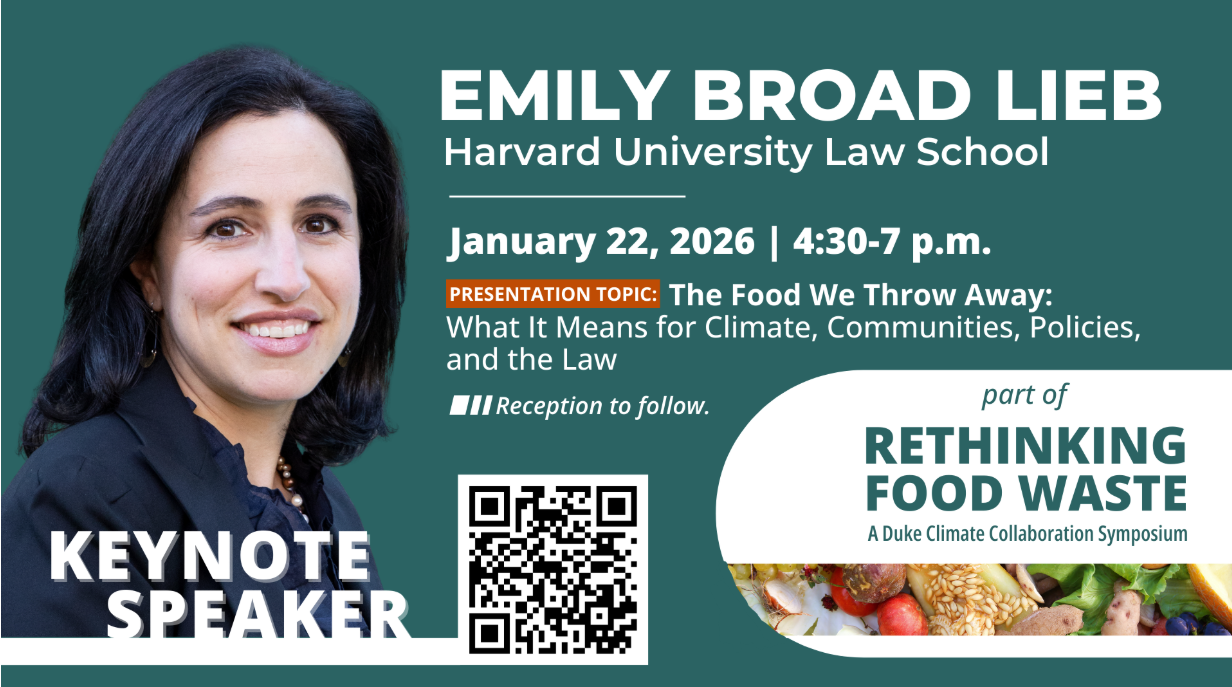 | Rethinking Food Waste Symposium Keynote Lecture Emily Broad Leib gave a keynote lecture at the Rethinking Food Waste Symposium hosted by the Duke Sanford World Food Policy Center in January. Titled, “The Food We Throw Away: What It Means for Climate, Communities, Policies, and the Law,” her lecture laid out the current state of food waste in the U.S. and focused on systems-level approaches to reduction using law and policy initiatives. She examined recent policy developments, trends, and hot topics in food waste policy in the U.S., and placed these developments in an international context, sharing findings from a global comparative food waste policy analysis and highlighting notable policy approaches from other countries around the world. | |  | | | |  | FDA, USDA, MAHA, SNAP, WIC…WTF? FLPC: AMA! The Food Law & Policy Clinic (FLPC) held a lunch time AMA (Ask Me Anything) session for Harvard Law Students in November to feed their curiosity about food law and policy in the U.S. and across the world, while also providing them with information about the clinic. FLPC students from the Fall 2025 semester described their projects, ranging from reviewing U.S. food additive regulations to supporting food donation policies across the globe to promoting sustainable seafood production, and explained what brought them to FLPC, what they learned in conducting their projects, and what made their experience in the clinic so worthwhile. | | 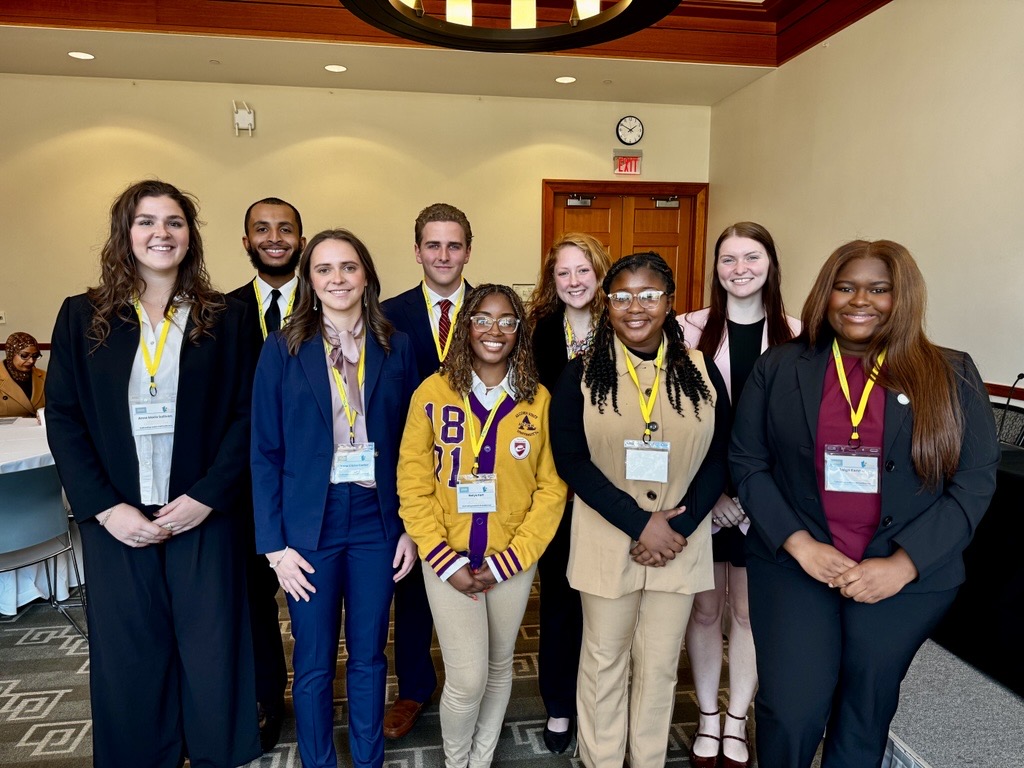 | Mississippi Delta Celebration Lunch & Reception The Mississippi Delta Project held its annual Delta Celebration in November. The celebration brought together members of the Harvard community who share a commitment to the Delta region and to supporting rural communities. In attendance were partners from the Mississippi Delta region and the Delta Scholars. The event included a lunchtime fireside chat with Dr. Oscar Brookins, emeritus faculty in the College of Social Sciences and Humanities at Northeastern University, who discussed themes from his memoir about growing up in Mississippi. | | | | | | | | | | | | | | | | Oscar Heanue: From FLPC to Food & Health Policy Watchdog FLPC Alumni Oscar Heanue knew before entering law school that he wanted to pursue a public interest career, but he says it wasn’t until arriving at HLS “that I discovered the wide variety of issue areas and opportunities to practice on exciting issues. Working with FLPC helped me identify my interest in food law and policy, which has now blossomed from an interest into a career.” Oscar currently serves as a litigation attorney at the Center for Science in the Public Interest (CSPI), a non-profit food and health watchdog. CSPI advocates for evidence-based nutrition and food safety policies, holds corporations and government agencies accountable, and provides consumers with unbiased information to live healthier lives. In his role, Oscar litigates cases that help CSPI advance its goals of better health and nutrition – usually through litigation against executive agencies under the Administrative Procedure Act, or through consumer class actions against industry. Cases taken on by CSPI's Litigation Department can span a variety of different issue areas, from defending a more plaintiff-friendly "reasonable consumer" standard in the Second Circuit, to suing the Department of the Treasury for failing to act on a request that alcoholic beverages be subject to certain basic labeling requirements. Know an alumni doing work that we should highlight? Send us an email. | | | | | | | | | | | | | | The Harvard Law School Food Law and Policy Clinic (FLPC) serves partner organizations and communities by providing guidance on cutting-edge food system issues, while engaging law students in the practice of food law and policy. FLPC’s work focuses on increasing access to healthy foods, supporting sustainable production and food systems, promoting community-led food system change, and reducing waste of healthy, wholesome food. FLPC is committed to advancing a cross-sector, multi-disciplinary and inclusive approach to its work, building partnerships with academic institutions, government agencies, private sector actors, and civil society with expertise in public health, the environment, and the economy. Learn more about FLPC. | | | | | | | | | | | |